Own account or funded: what actually changes
Almost everything written about this compares capital: "with a funded account you trade capital you never put up." True, and beside the point.
The choice between own account or funded is not decided by how much money you move. It is decided by what happens the day you have a bad day — and that day arrives in both.
The same bad day, two endings
Example: you lose 4% in a session, and the daily limit on your funded account is exactly 4%. A bad run, one forced entry, it doesn't matter.
Own account      −4%  →  tomorrow you trade on with 100% − 4% = 96%
Funded account   −4%  →  if the daily limit is 4%, that's the end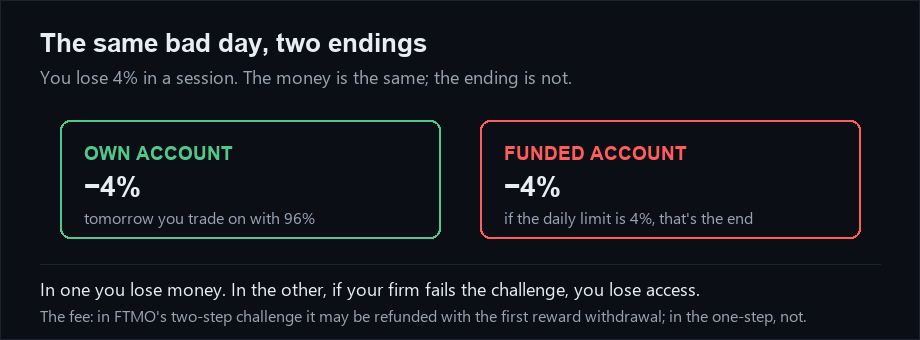
In the first you lost money. In the second, if your firm fails the challenge when the limit is hit, you lost access, and with it what you paid for the challenge. The capital was never yours; the opportunity was, and it does not come back.
Each firm sets its own figure and its own consequence. FTMO, for example, sets the maximum daily loss at 5% of the initial capital in its two-step challenge and at 3% in the one-step version (rules checked in October 2026).
🔑 That is what you are buying in a funded account: not capital, a rule set. And rules do not negotiate with you at five on a Tuesday afternoon.
What happens if you fail a prop firm challenge
It depends on the firm. At FTMO, exceeding the maximum daily loss is a breach of a basic rule, and the challenge is deemed unsuccessful. Within that challenge there is no second chance, and it does not matter that your overall loss had room to spare (checked in October 2026).
What you lose:
| The challenge fee | In FTMO's two-step challenge, between €89 and €1,080 depending on size (published prices). It may be refunded with the first reward withdrawal; in the one-step challenge it is not refunded (terms, checked in October 2026) |
| The time | Weeks of trading that count for nothing |
| The momentum | Starting again with the head of someone who already failed once |
The third is the expensive one, and it appears in no comparison table.
Are prop firms regulated?
The account itself, no — at least in Spain, where the regulator has said so in writing. In a notice dated 6 June 2019, the CNMV stated that neither opening "funded trading accounts" nor the courses tied to them fall within its remit. It does supervise what is done from those accounts in the markets. And the same notice warns of the risk of fraud or deception. The notice is a PDF; the news agency Servimedia reported it in the CNMV's own words.
Nor do these firms present themselves as brokers. FTMO, for example, states that all the accounts it provides to clients are demo accounts with fictitious funds, and that trading takes place in a simulated environment. You sign an agreement with a private company. Which means that if one closes, changes the rules mid-way or disputes a payout, you do not have behind you the body you would have with a supervised broker.
This is not an argument against using them — plenty of people use them. It is an argument for not putting there what you cannot afford to lose, and for reading the payout terms before the trading ones.
How much capital do you need to trade your own account
The question is badly put, which is why almost nobody answers it well.
You do not need a figure: you need your risk per trade to be executable. The broker will not let you open less than its minimum volume — in MetaTrader 5 that is the SYMBOL_VOLUME_MIN property of each symbol — and that minimum sets the smallest risk you can execute with a given stop. If your plan asks for less than that, you cannot execute your own plan.
That gives you the real number:
minimum capital = (min lot × point value per lot × typical stop) / risk per tradeExample: your broker accepts 0.01 lots, a point is worth €10 per lot and your typical stop is 20 points. The smallest trade you can open risks 0.01 × 10 × 20 = €2. If your plan risks 0.5% per entry, you need 2 / 0.005 = €400 to be able to execute it. With a 100-point stop and 0.25% per entry, the smallest trade risks 0.01 × 10 × 100 = €10, and you need 10 / 0.0025 = €4,000.
And that is the minimum to open a trade, not to fine-tune its size: volume moves in steps, so close to the minimum your real risk jumps from step to step.
Below that, your own account forces you to risk more than your plan says — and then the plan is not your plan. There a funded account is not a convenience: it is a way to trade the correct size.
How is a funded account taxed
Two different things, and worth not mixing them up. What follows is the Spanish case:
- Own account: according to the Spanish tax agency's manual for the 2025 return, capital gains and losses that arise from transferring assets go to the savings base of income tax. The scale for that base starts at 9.50% for the state plus 9.50% for the region: 9.50% + 9.50% = 19% in the first bracket. Whether your trading falls under that is for a tax adviser to confirm.
- Funded account: you are not selling anything of your own: a company pays you under a contract. Do not assume it is declared the same way as your own account. How what you receive is classified is a question for a tax adviser.
I am not your adviser and this is not tax advice: ask one before you collect your first reward. It is here because it changes the comparison. FTMO, for example, pays out 80% of the profit in its two-step challenge (checked in October 2026). An 80% taxed one way and a 100% taxed another cannot be compared by eye.
Own account or funded: so which one?
Neither is better. They solve different problems:
| If your limitation is… | Then |
|---|---|
| Capital — you cannot execute your plan at the right size | Funded |
| Discipline — you break your own rules | 🔴 Neither, yet |
| Nothing — you have capital and a method | Your own, and you sleep better |
The middle row is the important one, and the one nobody wants to read. A funded account does not fix indiscipline: it charges for it. What on your own account is a bad month can be, there, the end of the road.
What actually decides it, and it is not the capital
If you go funded, the daily limit stops being advice and becomes the line everything depends on. And it is a line that has to be watched continuously, because it can be crossed without closing a single trade — on floating equity, in ten seconds, without appearing in your history.
That is no longer an account decision: it is an instrumentation one. (We take it apart in The daily loss limit does not measure what you think.)
Stancel is a desktop app for MetaTrader 5 that draws your open risk and the allowance you have left over the chart, and measures the day's loss against your limit on every tick. It works the same on your own account; on a funded one, that limit is what decides whether a bad day is the last one.