Correlation risk: three trades are not three risks
Almost all the material on risk management explains how to size one position. That is the easy part, and it is the part nearly everyone gets right.
The problem is not the trade: it is the correlation risk of the second and the third, open at the same time.
The plan, and what happens
Suppose you hold 3 trades and risk 0.5% on each: the maximum planned loss is 3 × 0.5% = 1.5%.
Now look at what they are:
EURUSD   long   0.5%
GBPUSD   long   0.5%
AUDUSD   long   0.5%
You do not have three independent trades. You have three correlated trades: one short-dollar position split across three tickets, paying three commissions and three spreads.
All three quote against the dollar, like almost everything in currencies: according to the Bank for International Settlements, the dollar was on one side of 89.2% of all trades in April 2025. If the dollar strengthens, all three tend to lose together, though not necessarily by the same amount. Your planned risk looks more like a single position than like three — and in a sharp move, with slippage and spread widening, it can turn out worse.
The arithmetic is right. What is wrong is believing they are independent.
The correlation risk that turns three into one
The real error is not the one above. It is this one, and it is what eats funded accounts:
If your three trades were genuinely independent, you would not normally expect all three to lose on the same day. So a careful trader adding up the risk of independent positions is, in practice, risking less than the sum — and gets used to that cushion.
Then size goes up. Not out of greed: because experience says real risk is lower than computed risk. And for months, experience is right.
The day everything moves at once, the cushion disappears and the computed risk is collected in full, on a size that was calibrated for a world of independent positions. And that day tends to be a bad day: in episodes of stress, assets that used to offset each other fall together. The International Monetary Fund described it in February 2026 for stocks and bonds.
Correlation is not a fine adjustment. It is the mechanism by which a system that worked for two years can blow up in an afternoon.
How to calculate net currency exposure
You do not need a correlation matrix. You need to count.
For FX: look at net exposure per currency, not per pair. Every pair is two currencies, one long and one short.
EURUSD long 0.5%  ->  EUR +0.5   USD −0.5
GBPUSD long 0.5%  ->  GBP +0.5   USD −0.5
AUDUSD long 0.5%  ->  AUD +0.5   USD −0.5
                      ────────────────────
                      USD 3 × (−0.5) = −1.5   <-- your actual trade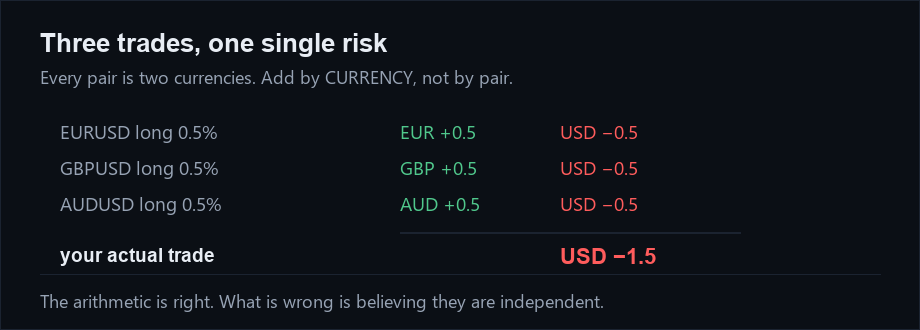
That last line is your risk. The other three look like three small risks on three different things; the dollar one is a single risk, the sum of the three, on one thing.
For indices: do not assume that four indices are four risks. The prudent assumption is that the US indices — S&P, Nasdaq, Dow, Russell — are correlated until you have measured it yourself: four positions across four US indices count as one position with four names. And if you look for diversification in indices from other regions, measure that too before taking it for granted.
For commodities: gold and silver move in the same direction, and silver moves harder. According to the World Gold Council, silver amplifies gold's moves and its volatility is roughly twice that of gold (report of March 2026). Two positions in the same direction in the two metals are not two independent risks.
The three-strategy illusion
There is a version of this error that fools even people who understand correlation: running three different systems at once.
A trend follower, a mean reverter and a range-breakout system sound like perfect diversification. And they are, along the axis of logic.
But if all three trade the same markets in the same hours, then along the axis that matters — what happens when the market moves a lot at once — they can end up aligned, and then your real exposure is not the sum of three separate plans.
The question that settles it is not "are these different strategies?" It is "can all three be open, in the same direction, in the same market, at the same time?" If the answer is yes, it needs an explicit limit, because it will happen.
How much total risk can I have open at once
The practical conclusion fits in one sentence: the useful limit is not per-trade risk, it is total simultaneous risk.
An honest plan has both.
Example of a plan with both limits
The values are the ones we use ourselves. They are not a standard: adjust them to your account.
| Limit | Example value | What it protects |
|---|---|---|
| Risk per trade | 0.1% – 0.5% | that one bad entry does not matter |
| Total simultaneous risk | 1% – 2% | that one bad day does not matter |
| Net exposure per currency or sector | equal to the total | that three tickets are not one |
The limit almost nobody writes down
The middle one is what almost nobody writes down, and it is the only one that speaks the same language as a prop firm's daily limit. A daily limit like FTMO's is measured on equity: the balance plus the result of all open positions, with their swaps and commissions. Everything open counts at once (rules checked in October 2026).
If your plan limits per-trade risk and not simultaneous risk, you are computing one thing and being evaluated on another.
And why it has to be visible, not calculated
Everything above can be done in a spreadsheet before you open. The problem is that positions do not open all at once: they open across the morning, each with its own reason, and nobody recomputes net exposure on the third one.
So this is not a discipline tip. It is an instrumentation requirement: simultaneous risk has to be on the screen, updating, before the third entry is a decision.
A number you have to work out by hand is a number nobody consults on the day it matters.
Stancel draws your open risk and the allowance you have left for the day over the chart. It was built for this exact question: the one nobody asks on the third entry.